Where Is the Saint Paul Family Market Located
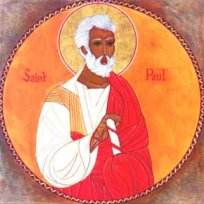 Of all the apostles, Saint Paul stands out every bit the one who was the traveler par excellence. His journeys through the length and breadth of the ancient earth are nothing short of remarkable and given the difficulties of traveling in these times, allow lone the animosity and danger he faced trying to convert populations to the new organized religion, it is a credit to the endurance and tenacity of the human being that he accomplished as much as he did. Paul, originally Saul, was born in Tarsus in what is now southern Turkey and changed his proper name afterwards converting Sergius Paulus. He is traditionally represented as a stocky piddling man, with a baldheaded head and a grey, bushy beard. He studied Jewish constabulary in Jerusalem under the famous rabbi Gamaliel (Acts 22:3). He and his parents were Roman citizens, having special rights and privileges. Roman citizens could non be imprisoned without a trial nor could they be scourged or crucified. His Roman citizenship saved Paul many times during his ministry. He made 3 bully missionary journeys before beingness arrested in Jerusalem and taken to Rome where he was beheaded in AD 62.
Saul witnessed the stoning and death of Stephen, the first Christian martyr, and guarded the clothes of his executioners (Acts seven:58). He then started persecuting the Christians and imprisoned many of them (Acts 8:3). The followers of Jesus Christ were regarded every bit heretics by the Pharisees. The persecution in Jerusalem acquired the believers to disperse away and preach the Give-and-take everywhere they went (Acts 8:4).
Saul planned to persecute Christians even abroad. He obtained letters to the synagogues in Damascus from the high priest in Jerusalem, and fix out to bring Christians bound from in that location to Jerusalem. On the route to Damascus the almost famous conversion in the history of Christianity took place, described in Acts, chapters nine,22 and 26. At midday, lite shone down suddenly from heaven, encompassing Saul. He heard Jesus Christ's vox,
Saul, Saul, why persecutest yard me?
This man who hated Christ and all Christians capitulated in the forepart of the living God. Then Jesus told him to become into Damascus, and in that location he would be told what to do. Paul became blind and did not swallow or beverage for three days. In Damascus, the Lord sent a disciple called Ananias to him, who restored his vision, filled him with the Holy Spirit and baptized him. After his conversion, Saul is mentioned in the Bible by his Latin proper noun, Paul. He and so began to preach near Jesus in the synagogues in Damascus. The Jews wanted to kill him, but he escaped with the help of some Christians who lowered him in a basket from the top of the city wall.
Paul went away to Arabia for a period of time, then returned to Damascus (Gal. 1:17), and after 3 years journeyed to Jerusalem (Gal. one:xviii). The disciples there did not trust him, knowing he had previously persecuted Christians, but Barnabas took him to the apostles who were staying in Jerusalem at that time (Gal. 1:18-19, Acts 9:26-27). Paul preached boldly in Jerusalem, just after 15 days had to flee once again, this time to Tarsus (Acts 9:29-30).
In Antioch, the capital letter of Syrian arab republic and then, Gentiles were turning to Jesus Christ, and the church in Jerusalem sent Barnabas at that place to instruct these new believers. Barnabas in turn took Paul from Tarsus to be his companion (Acts 11:nineteen-25). The disciples were get-go called Christians in Antioch (Acts 11:26). Christians in Antioch sent relief funds past Barnabas and Paul dorsum to Christians in Judea (Acts eleven:27-thirty). They returned with immature John Mark, Barnabas' nephew from there (Acts 12:25).
Paul's Letters
The New Attestation contains fourteen epistles written by Paul to Christian congregations and individuals:
- Romans
- Kickoff Corinthians
- 2nd Corinthians
- Galatians
- Ephesians
- Philippians
- Colossians
- First Thessalonians
- Second Thessalonians
- First Timothy
- Second Timothy
- Titus
- Philemon
- Hebrews
Please click on the link in order to read Paul's alphabetic character to Ephesians.
2008 Saint Paul Year
Pope Benedict XVI has declared 2008 the "Year of St Paul" in accolade of the saint, to marking 2000 years since St. Paul's birth. The ceremony year formally began on the 28th of June 2008 and gathered millions of Christian pilgrims to his birth boondocks Tarsus, in southeastern Turkey.
PAUL'Southward MISSIONARY JOURNEYS
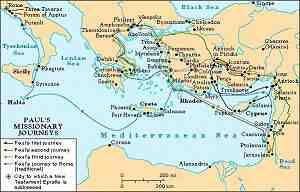
On all of his journeys he traveled along the coast of Asia Pocket-sized and there are many places along the declension where he stopped and taught, or inverse boats, or sheltered from the weather. The Book of Acts covers near of his exploits and journeys as well as his last voyage as a prisoner to Rome.
At the instruction of the Holy Ghost, the leaders of the church building in Antioch sent out Barnabas and Paul as missionaries (Acts 13:1-3). Paul's missionary trips are described in the Book of Acts and are divided into 3 separate journeys plus a terminal journeying to Rome.
Get-go journey with Barnabas and John Marking
Acts thirteen:four-14:28
Paul, Barnabas and John Mark departed to Seleucia, from where they sailed to Cyprus. On Cyprus they preached in Salamis and Paphos. In Paphos a sorcerer Jew, a imitation prophet named Barjesus turned against them before the Roman deputy of the island, simply God blinded him. As a result, the deputy became a believer in Jesus Christ. From Cyprus the three men sailed dorsum to the mainland of Asia Small-scale, to Perge in aboriginal Pamphylia, where John left them and returned to Jerusalem.
Paul and Barnabas journeyed to Antioch in Pisidia, where many Jews and Gentiles accepted the word of God and believed afterwards hearing them preach. Merely the unbelieving Jews stirred upwardly persecution confronting Paul and Barnabas and expelled them out of their coasts. The same thing happened in Iconium (Konya), where unbelieving Jews and Gentiles planned to stone them. They fled to Lystra, where Paul healed a crippled man and as a result the people thought they were gods and wanted to sacrifice to them, only Barnabas and Paul managed to finish them. The aforementioned crowd later stoned Paul and left him to dice, when certain Jews arrived in the urban center from Antioch and Iconium and stirred up the people against the apostles. Paul survived and departed with Barnabas to Derbe the side by side twenty-four hour period. Then they returned again to Lystra, Iconium, Antioch, Perge, to strengthen believers and ordain elders in every church. From Attalia (Antalya) they sailed back to Antioch, where they gathered the church together to tell them most their experiences and how God "opened the door of organized religion unto the Gentiles".
The council in Jerusalem (Acts xv:1-32)
Some Jewish Christians from Judea told Gentile Christians in Antioch, that they should circumcise themselves and keep the Constabulary of Moses in order to exist saved. To decide this fundamental question, Paul, Barnabas and some other Christians were sent from Antioch to Jerusalem to the apostles and elders. A conference was held in Jerusalem, where the church leaders, inspired past God, declared that Gentile Christians are equal to Jewish Christians and they did not have to be circumcised or go along the law to exist saved, considering religion in Jesus Christ is sufficient, only they should abjure from meats offered to idols, blood, strangled animals and from fornication. A letter of the alphabet was sent nearly these decisions to the Christians in Antioch by Paul and Barnabas, and two prophets, Judas Barsabas and Silas, to confirm its content.
Second journey with Silas
Acts 15:36-18:22
Paul and Barnabas planned to visit the churches they planted on their showtime journey. Barnabas wanted John Mark to accompany them, but Paul disagreed, so Barnabas took Marker and sailed to Republic of cyprus, while Paul chose Silas and went through Syria and Cilicia, strengthening the churches everywhere. Paul and Silas then visited Derbe and Lystra (virtually Konya), where Paul chose a immature Christian named Timothy to accompany them. They went through Phyrgia and Galatia and arrived in Alexandria Troas, where the Lord told Paul in a vision to go to Republic of macedonia to preach.
Luke, the evangelist probably joined them in Troas, for from this signal on he begins referring to the missionaries as "We". The 4 men sailed to Europe to Samothracia, Neapolis and to Philippi, where a godly woman named Lydia invited them into her firm after she and her household was baptized. In Philippi Paul healed a demon-possessed slave daughter, who made a profit for her masters past soothsaying. As she was non able to make profit after this, her masters brought Paul and Silas to the magistrates. They were beaten and bandage into prison, but at midnight, as they prayed and sang praises to God, an earthquake shook the prison, all the doors opened and anybody'southward bands were loosened. Paul and Silas so preached the gospel to the frightened jailer and his household, and all believed and were baptized on the aforementioned night. Paul and Silas were publicly freed by the magistrates themselves the adjacent mean solar day.
The four men then passed through Amphipolis and Apollonia and went to Thessalonica, a main seaport and an important commercial center in Macedonia, where Paul spoke in the synagogue of the Jews on three Sabbath days. Some of the Jews and many Greeks believed, merely the unbelieving Jews stirred some crowds confronting them, so Paul and Silas had to leave the metropolis by night. They moved on to Berea, where the Jews were more noble than those in Thessalonica, in that they received the word and searched the Scriptures to come across if those things were so. Many Jews and Greeks in Berea believed, but the Jews of Thessalonica came to Berea and stirred upwardly the people again. Afterwards, Paul went to Athens, a city full of idolatry and pagan philosophers. He disputed in the synagogue and in the marketplace daily, and preached on the Areopagus. A few Greeks believed him but the others mocked.
Paul and then journeyed to Corinth, one of the largest cities in the Roman Empire, where he convinced many Jews and Greeks, among them the chief ruler of the synagogue and all his household. In a nighttime vision Lord Jesus encouraged Paul to proceed to speak in Corinth, so he preached in the urban center for a yr and a half. The Jews at that place stirred up persecution against Paul and tried to indict him in front of Gallio, the Roman deputy, but Gallio did non listen to them. Paul and then sailed to Ephesus, the uppercase of the Roman province of Asia, where he stayed for a short time. He traveled to Jerusalem for the Passover, and then back to Antioch.
Tertiary journeying
Acts 18:23-21:16
After spending some fourth dimension in Antioch, Paul revisited the churches in Galatia and Phyrgia to strengthen the disciples, and then went to Ephesus. In Ephesus Paul institute twelve followers of John the Baptist and baptized them in the name of Lord Jesus Christ. He laid his hands on them and the Holy Ghost came on them and they spoke with tongues and prophesied. Paul preached in the synagogue for 3 months, but when some hardened unbelievers spoke evil before the multitude, he separated the disciples from them and chose some other identify to teach daily. He continued this for two years, then that all Jews and Greeks in the Roman province of Asia (part of Asia Minor) heard the gospel of Christ. God did special miracles in Ephesus through Paul, every bit even the garments worn by him healed the sick and the demon-possessed. Many believed in Ephesus and many who practiced magic before brought their books together and burned them publicly. As many pagans turned to Christianity in Ephesus, formerly a center of heathen Diana worship, craftsmen and silversmiths, who manufactured idols and shrines, saw their profit diminishing. These craftsmen stirred upwards the pagans against Paul and his companions, but nobody was hurt in the end.
I of the most well known incidents on Paul's travels is the anarchism of the silversmiths in Ephesus. Towards the end of his fourth dimension at that place Paul preached that "...gods made past man hands are non gods at all", a directly jibe at the silversmiths who made silver statuettes of Artemis and the temple for sale to pilgrims and tourists. Sales soon began to decline and one, Demetrius, a leader of the silversmiths, led a group of artisans confronting Paul proverb "...the sanctuary of the cracking goddess Diana will cease to command respect; so it will not be very long before she who is worshipped by all Asia and the civilized world is brought downward from her divine pre-eminence". His voice communication acquired an uproar and the ring of silversmiths, and likely a number of merchants worried about the pass up in business, rushed into the theatre shouting "Great is Diana of the Ephesians". Paul was not forced to leave the city by the authorities later on this riot, simply he evidently decided information technology was prudent to practice and then and ready off for Macedonia.
Paul revisited the churches in Macedonia, then went to Hellenic republic, where he stayed for 3 months. Every bit he was about to sheet to Syria, some Jews laid wait for him, then he returned through Republic of macedonia. In Alexandria Troas he raised upward a beau who died after he fell down from the third floor of a house where Christians were gathered. Paul departed to Assos, from where he sailed with other disciples to Miletus via Mitylene, Chios, Samos and Trogyllium. In Miletus he met with the elders of the church building from Ephesus and in his moving spoken language he bid good day to them, knowing he would never see them again. He charged them to feed the flock, and warned them that wolves would enter their congregation and men would speak perverse things to describe away disciples.
From Miletus they sailed to Cos, Rhodes, Patara and Tyre, Syrian arab republic, where disciples inspired by the Holy Spirit warned Paul not to become upwards to Jerusalem. Paul and his companions departed to Ptolemais, and so to Caesarea, where a Judean prophet named Agabus prophesied that Paul will be bound by the Jews in Jerusalem and will exist delivered into the hands of the Gentiles. The disciples tried to persuade Paul not to go up to Jerusalem, but Paul answered that he is set not but to be bound, but also to die for Jesus Christ, so they went up to Jerusalem.
Paul in Jerusalem (Acts 21:17-23:30)
In Jerusalem Christians received Paul and his companions gladly, simply some Jews from Asia stirred up the people confronting him and accused him of bringing Gentiles into the temple. The people wanted to beat and then kill Paul. Roman guards saved Paul but at the same time took him into custody. On the stairs of the castle, before the multitude, Paul gave a speech communication in his defense and a testimony of his conversion in Hebrew, but when he said he was sent by Jesus Christ to the Gentiles, the Jews made such an uproar, that the captain wanted to interrogate him by scourging. Paul appealed to his Roman citizenship and then they did not dare affect him. The side by side day the helm led Paul before the Sanhedrin, where Paul told he was a Pharisee and believed in the resurrection of the dead. This divided the Pharisees and Sadducees in the council, a not bad dissension arose and the Romans had to rescue Paul again. Hearing that more than than 40 Jews fabricated a vow and conspired to impale Paul, the chief helm sent him past night to Caesarea to Felix the governor.
Paul in Caesarea (Acts 23:31-26:32)
After v days, the elders and the primary priest arrived in Caesarea and defendant Paul earlier the governor of profaning the temple but couldn't testify annihilation, so Felix deferred them merely left Paul in custody. After two years Felix was replaced by Festus, who asked Paul's accusers to come to Caesarea again. They couldn't prove whatever of their many complaints against Paul. Every bit a Roman citizen, Paul then appealed to Caesar. While he was waiting to go to Rome, Male monarch Agrippa and Bernice arrived in Caesarea, and one day Festus brought Paul before them. Acts 26 records Paul'southward speech, where he tells his upbringing, his quondam madness against Christians, his conversion on the road to Damascus and his preaching of the gospel to both Jews and Gentiles. Here nosotros find the almost consummate version of what Jesus said to him on the road to Damascus. Male monarch Agrippa said to Festus that Paul had done nothing wrong and he could accept been set gratis, had he not appealed unto Caesar.
Journey to Rome
Acts 27:1-28:31
Festus then sent Paul with other prisoners and soldiers on a send to Rome. This journeying is described in Acts 27 and 28: "And putting to sea from thence, we sailed under the lee of Cyprus, because the winds were contrary. And when nosotros had sailed across the sea which is off Cilicia and Pamphylia, we came to Myra, a city of Lycia. And there the centurion constitute a transport of Alexandria sailing for Italy; and he put us therein. And when we had sailed slowly many days, and were come with difficulty over against Cnidus, the wind not farther suffering us, we sailed under the lee of Crete, over against Salamone; And with difficulty coasting along it nosotros came unto a certain place called Off-white Havens; nigh whereunto was the metropolis of Lasea."
Information technology was by now the beginning of winter and the voyage onwards was beset with strong and agin winds. From Crete a gale blew them down to Malta. After many dangers and a storm, during which God's angel informed Paul in a vision that everybody on the transport would survive, the ship was wrecked on the island of Melita (Malta) in what is now called St Pauls Bay but everybody escaped rubber to land. Many miracles happened during their 3-month stay on the isle. Paul healed many diseased people and he got bitten by a viper, but this did not harm him. After iii months they boarded another transport and arrived in Rome. Christians in Rome received Paul warmly. In Rome Paul was placed under house arrest. He lived in a rented house for two years and could receive visitors, so he could proceed didactics and preaching God's kingdom. He invited the chiefs of the Jews to hear the gospel, later on which some of them believed and some non. Paul concluded his speech with the following: "Be information technology known therefore unto you, that the conservancy of God is sent unto the Gentiles, and that they will hear it."
Paul was beheaded in Rome around AD 67, the same twenty-four hour period Peter was crucified. It is apocryphally told that when Paul was beheaded milk and non claret flowed from his body. Withal dubious this may be, few could have predicted what the event of Paul's work was to exist as Christianity went from strength to strength to get the ascendant organized religion in the country where he met his stop.
The Cities Where Paul Preached
| Metropolis | Explanation |
|---|---|
| Antioch | Capital of ancient Syria, the eastern upper-case letter of the Roman Empire, the modern Antakya province in southern Turkey |
| Antioch in Pisidia | Nearly the border of aboriginal Pisidia, in Yalvac, a few kilometers south-west from modern Aksehir, central Turkey |
| Athens | Greatest urban center of classical Greece, capital of modernistic Greece |
| Berea | City of aboriginal Macedonia, modern Veria in Greece |
| Caesarea | Seaport of aboriginal Palestine, capital of the Roman province, modernistic Tel Aviv-Yafo in Israel. Non to be confused with Caeserea (Kayseri) in Turkey |
| Corinth | City of aboriginal Hellenic republic, virtually modernistic Corinth, southern Greece |
| Damascus | Urban center of ancient Syria, capital of modernistic Syria |
| Derbe | Ancient city in south-eastern asia Small, modernistic Turkey, near Konya |
| Ephesus | Town on the western declension of Asia Minor, 70 km due south of modern Izmir, Turkey |
| Iconium | Capital of the ancient province of Lycaonia in Asia Minor, modern Konya in central Turkey |
| Jerusalem | Former capital of the southern Kingdom of Judah and the identify of the temple of God, the upper-case letter of modern Israel |
| Lystra | City of the ancient province of Lycaonia in Asia Minor, near province of Konya |
| Miletus | Coastal city of ancient Ionia, 50 km south of Ephesus and 100 km south of modern Izmir in the Aegean region |
| Paphos | Boondocks in south-western Republic of cyprus on the coast of the Mediterranean Sea |
| Perge | Capital letter of aboriginal Pamphylia in Asia Minor during the Roman period, a few kilometers north of mod Antalya |
| Philippi | City of ancient Macedonia, near modern Kavala, Greece |
| Rome | Capital of the Roman Empire and Italia, located on Tiber River |
| Salamis | Boondocks located on the e end of Cyprus, 5 km north-west of modern Famagusta |
| Tarsus | Metropolis of ancient Cilicia on the river Cnydus near the Mediterranean Sea, near Adana province in southern Turkey |
| Thessalonica | Littoral city of aboriginal Macedonia, modern Szaloniki in northeastern Hellenic republic |
| Troas | On the coast of northwestern Anatolia, nearly Canakkale |
| Tyre | City on the key coast of ancient Phoenicia, modern Sur in southern Lebanese republic |
Bibliography
zimmermandifebath.blogspot.com
Source: https://www.allaboutturkey.com/saint-paul.html

Post a Comment for "Where Is the Saint Paul Family Market Located"